


A precise architectural elevation and reshaping of the breast to restore a firm, youthful profile and correct structural drooping.
Pregnancy, nursing, weight fluctuations, and gravity inevitably stretch the skin envelope and internal suspensory ligaments (Cooper's ligaments) of the breast. The result is ptosis-a condition where the breast tissue deflates, the volume shifts downward, and the nipple descends below the breast crease.
A Mastopexy, or Breast Lift, is a highly effective reconstructive procedure that reverses this descent. By removing excess, inelastic skin and meticulously reshaping the underlying glandular tissue into a tighter, higher cone, Dr. Gandhi permanently elevates the breast and repositions the nipple to its youthful, forward-projecting apex.

If you are completely satisfied with the volume of your breasts when wearing a highly supportive push-up bra, a Mastopexy alone is the perfect procedure. It uses your own natural tissue to create that exact supported shape without any synthetic devices.
However, if your breasts have significantly deflated (lost internal volume) after nursing, a lift alone will result in a higher, but smaller breast. In this case, an Augmentation-Mastopexy is required. Dr. Gandhi simultaneously places a small silicone implant to restore the lost volume while lifting the skin, achieving both perfect position and perfect fullness.
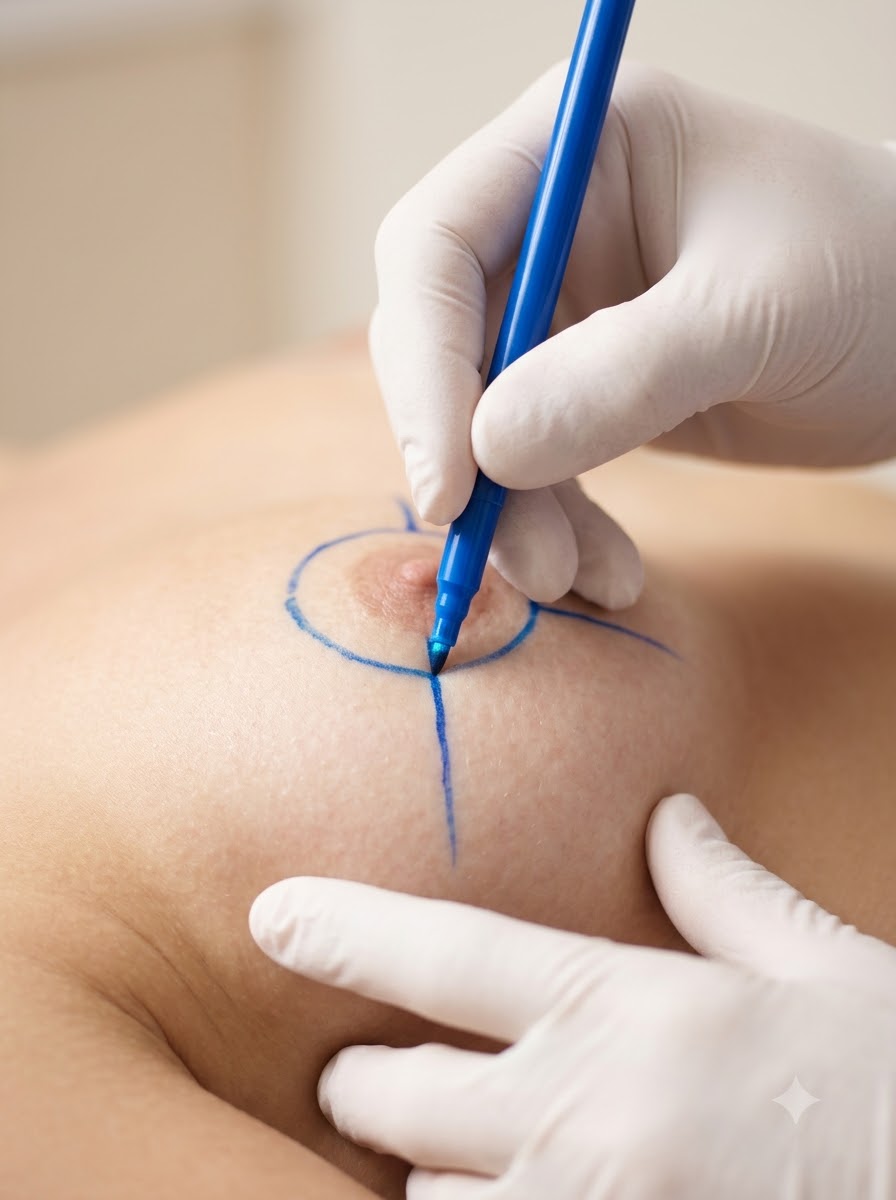

The traditional breast lift relied heavily on the skin to hold the breast in its new, higher position. Over time, gravity always wins against skin, causing the lift to bottom out and droop again.
Dr. Gandhi employs advanced internal structural techniques, often referred to as an Internal Bra mastopexy. He utilizes strong, deep-tissue sutures to anchor the actual breast parenchyma (the dense glandular tissue) directly to the chest wall fascia. This transfers the weight of the breast entirely onto the muscle wall, taking all tension off the skin incisions. The result is a profoundly beautiful, long-lasting lift that defies gravity and heals with incredibly fine, faint scars.
"A breast lift changes the shape; a breast implant changes the size. Patients often think they need implants to fix drooping, but placing a heavy implant into a stretched skin envelope will only cause it to droop faster. The foundation must be lifted first."
— Dr. Giriraj Gandhi
For patients with very minimal sagging. A tiny crescent-shaped piece of skin is removed directly above the areola. This slightly elevates the nipple but does not significantly lift the breast tissue itself.
For mild ptosis. A circular incision is made around the areola. Excess skin is removed like a donut, and the skin is pulled inward like a purse-string. It is excellent for reducing the size of large areolas while providing a mild lift.
The modern gold standard for moderate ptosis. It involves an incision around the areola and vertically down to the breast crease. It allows for significant reshaping and lifting, effectively narrowing a wide breast without a horizontal scar under the fold.
Reserved for severe drooping or massive weight loss patients. It utilizes the vertical pattern but adds a horizontal incision along the breast crease, allowing for maximum skin removal and comprehensive structural reconstruction.
Dr. Gandhi utilizes meticulous, nerve-sparing techniques. While it is entirely normal to experience temporary numbness or hypersensitivity as the nerves wake up during the first few months of healing, permanent loss of sensation is rare.
Depending on the technique used, many women can still breastfeed after a mastopexy, as the nipple remains attached to its underlying blood supply and milk ducts (a superior or medial pedicle). However, any breast surgery carries a slight risk of altering milk production.
Because Dr. Gandhi uses an internal bra technique, the skin incisions are closed with zero tension. This allows the scars to heal into extremely fine, flat lines. Over 12 to 18 months, they typically fade into faint white or flesh-toned lines that are easily concealed by any bra or bikini.
Depending on your age and medical history, we will require a baseline mammogram prior to surgery to ensure your breast tissue is entirely healthy before structural repositioning begins.
You must completely stop all nicotine products and vaping at least six weeks prior. A breast lift requires complex micro-circulation to keep the newly repositioned nipple alive; nicotine acts as a severe vasoconstrictor, risking necrosis.
You will be provided with specific guidelines to purchase soft, front-closing, wire-free surgical bras. You must not wear underwire bras for several months following the procedure, as the wire can dig into healing incisions.
You will wear your surgical bra 24/7. Small surgical drains may be placed to prevent fluid accumulation, which are removed painlessly within a few days. You must sleep on your back, slightly elevated, to minimize swelling. Pain is typically mild to moderate.
Most patients comfortably return to desk jobs by week two. Your breasts will initially look boxy or overly high on the chest; this is intentional. Over the next several weeks, the tissue will relax and drop and fluff into a beautiful, natural teardrop shape.
You are cleared to resume intense cardiovascular exercise and lower-body weightlifting, but should avoid heavy chest exercises (like bench presses) until the internal sutures are fully integrated. Incisions will continue to mature and fade throughout the first year.
A patient came to see me eleven months after losing close to 40 kilograms through diet, exercise, and eventually bariatric surgery. She was proud of the number on the scale, and...
6 Min ReadA patient came to a six week review holding her phone with the week two photo open next to the mirror. "It looked better ten days ago," she said. "The nipple position was higher...
7 Min ReadA patient in her mid thirties came in after breastfeeding two children, two and a half years apart. She described the same thing I hear from many women in this exact position: "...
6 Min ReadSchedule a private consultation at our Nigdi clinic to explore your surgical options with absolute discretion and expert guidance.